AI Automation: The Burden Falling on the Low-Wage and Marginalized

In May 2024, I lost my job to artificial intelligence. As a former Director of Professional Services at Servis.ai, the irony is hard to ignore. My nerdy ass was plugged into technology every day. I should've seen the disruption coming; maybe I could've shifted my role with more insight. Instead, my department disappeared in a wave of automation; even tech insiders can be blindsided by AI's exponential growth.
But my job loss revealed something deeper: if someone like me, could be caught off guard by AI's pace, what chance do people without my access and background have? The signs are everywhere. Family members who once navigated basic internet tasks now stumble through a world wide world shaped by algorithmic decisions and AI-generated propaganda. Despite the growing number of digital devices, without some digital literacy, exponentially moving technologies like AI keep charging forward, while vulnerable users are left struggling, manipulated, and too often used by systems invisible to them.
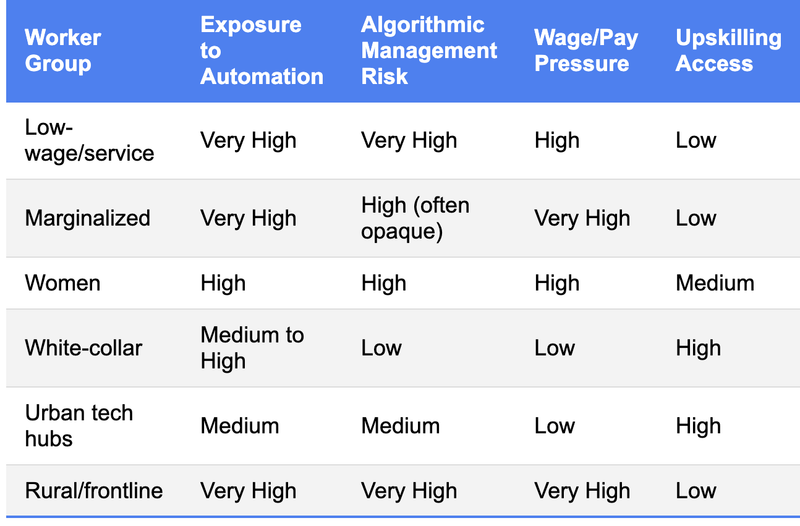
- AI automation is not neutral. AI disproportionately harms low-wage, low-skilled, minority, and female workers more than white-collar professionals.
- 'Disproportionate' means both higher risk of job loss (exposure) and greater difficulty recovering (adjustment costs).
- Mechanisms affecting marginalized groups most: task auto, algorithmic management, wage pressure, and friction in workforce reallocation
- Recent studies show greatest negative impacts are mostly in sectors and regions with most vulnerable workers.
- Even-though white-collar jobs are being impacted, the severity and recovery costs are higher for the disadvantaged
- Policy choices and employer strategies can either mitigate or worsen equity gaps.
1. AI Exposure Is Not Evenly Distributed
Low paying, low-skill, and marginalized workers are most exposed to job displacement risks from automation; especially routine repetitive tasks. Studies from OECD, Brookings, and IZA consistently show these marginalized groups are at the head of job loss; rural small towns, or old industrial regions.
2. Adjustment Costs Affect Marginalized Workers the Hardest
When jobs disappear, the costs of adjusting, retraining, and relocating fall disproportionately on those with less education, weaker social networks, and fewer financial fallback. These costs compound for Black, Latino, immigrants, and women who face bias, lack of childcare, or language barriers.
3. Algorithmic Management and Wage Pressure Intensify Inequities
Gig platforms and tech firms use AI to monitor, rank, and discipline workers, often cutting pay or "deactivating" people without cause. These impacts are felt more in service, warehouse, logistics, and ride-share sector; industries where workers of color and immigrants are mostly concentrated.
4. Who Is Most Affected?
- Income. The lower your wage, the higher your risk of automation.
- Race/Ethnicity. Black and Latino workers face a higher automation risk and barriers to new digital jobs.
- Gender. Women, are in roles at risk of displacement but also face steeper re-entry challenges.
- Geography. Disruption is most pronounced in rural and small towns, especially those already disadvantaged by past waves of disruption.
5. White-Collar Exposure Increasing, but Fallout Is Unequal
Newer forms of AI, such as generative AI, rapidly are transforming knowledge based industries, such as legal and paralegal fields. But, white-collar professionals generally have more resources to adapt; such as education, savings, social networks, and access to opportunities; and therefore more likely to be rehired into other, similarly higher-paying, roles.
What Does 'Disproportionate' Really Mean?
'Disproportionate', is not just about who will lose their jobs first, it's also how badly individuals are disadvantaged and how hard it may to recover; relatively. Researches differentiate between:
- Exposure; likelihood your job will be automated.
- Adjustment Cost; difficultly and cost to re-establish one's self; i.e. finding new employment, relocating
Disadvantaged groups face both higher exposure and higher adjustment costs.
AI Automation Impact
Works Cited
Brookings Institution. (2025, October 27). The geography of generative AI's workforce impacts will likely differ from past automation [Web article]. Retrieved from https://www.brookings.edu/research/geography-of-ai-workforce-impacts/
Human Rights Watch. (2025, May 11). The Gig Trap: Algorithmic, wage and labor exploitation in platform work [Report]. Retrieved from https://www.hrw.org/report/2025/05/11/the-gig-trap-algorithmic-wage-labor-exploitation
MIT Sloan School of Management. (2025, July 31). A new look at how automation changes the value of labor [Article]. Retrieved from https://mitsloan.mit.edu/ideas-made-to-matter/new-look-how-automation-changes-value-labor
OECD. (2024, October 30). Who will be the workers most affected by AI? [Web article]. Retrieved from https://www.oecd.org/employment/ai-workers-impact.pdf
OECD. (2025). Artificial intelligence and wage inequality [PDF report]. Retrieved from https://www.oecd.org/employment/artificial-intelligence-and-wage-inequality.pdf
Labor Center, University of California Berkeley. (2025, February 18). Data and Algorithms at Work: The Case for Worker Technology Rights [Report]. Retrieved from https://laborcenter.berkeley.edu/data-and-algorithms-digital-rights/
IZA, Institute of Labor Economics. (2024). AI, Task Changes in Jobs, and Worker Reallocation [PDF working paper]. Retrieved from https://docs.iza.org/dp16776.pdf
U.S. Bureau of Labor Statistics. (2022). Growth trends for selected occupations at risk [Web report]. Retrieved from https://www.bls.gov/
European Parliament. (2024). Addressing AI Risks in the Workplace [Policy document]. Retrieved from https://www.europarl.europa.eu/